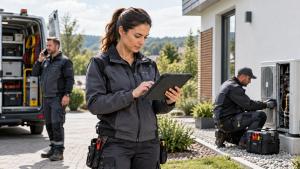
Mobile workforce management (MWM) is the process of coordinating employees who work away from a traditional office through connected technology, mobile tools, and structured workflows. For organisations managing field technicians, remote employees, or distributed teams, it provides the visibility and information needed to work efficiently wherever services are delivered.
Implementing this technology is usually a gradual process. Organisations typically move through five stages as they progress from manual processes to a fully connected and data-driven mobile workforce. Understanding these stages can help businesses assess their current position and identify opportunities to improve productivity, service quality, and operational efficiency.

How to Start: the 5 stages of Mobile Workforce
Stage 1: Manual Processes and Paper-Based Operations
At the earliest stage, field operations depend heavily on paperwork and manual processes. Job sheets are printed, schedules are distributed manually, and information from the field often reaches office teams with significant delays.
This creates several challenges, including poor communication, limited visibility of job progress, duplicated administration, and slower reporting and billing. Without real-time information, managers also have fewer opportunities to respond quickly when priorities change.
Stage 2: Starting with Mobility and Digital Data Management
The next step is introducing simple digital tools. Smartphones and tablets begin replacing paper forms, while email, messaging, and shared documents improve communication between field employees and office teams.
For the mobile workforce, this means information can be captured more accurately and transferred faster. However, data may still be spread across different systems, providing only limited operational visibility. Some organisations also introduce BYOD policies or basic location tracking at this stage, creating additional requirements around device management and security.
Stage 3: Connected Workforce Management
The third stage is where mobile workforce management becomes fully established. A centralized platform connects field workers, office staff, jobs, and operational data in real time.
Employees can receive assignments and notifications directly on their devices, follow guided workflows, update job statuses, and access essential information from the field. Meanwhile, managers gain dashboards showing job progress, workforce activity, and resource allocation.
Connecting the entire mobile workforce through one platform improves communication, creates greater consistency, and enables organisations to respond more quickly to changing circumstances.
Stage 4: Optimizing Schedules and Performance
Once teams are connected, organisations can focus on making operations more efficient. Intelligent scheduling and route optimization help ensure that jobs are assigned according to factors such as employee skills, availability, location, and workload.
Automation can also reduce administrative tasks through smart forms and structured data capture. For the mobile workforce, this means less time travelling or completing paperwork and more time delivering services.
Managers can move away from reactive scheduling towards proactive planning, improving productivity, first-time fix rates, and overall resource utilisation.
Stage 5: Data-Driven Management and Predictive Maintenance
At the most advanced stage, organisations use operational data to anticipate demand and continually improve workforce performance. Historical information and real-time insights can support forecasting, scheduling, resource planning, and strategic decision-making.
Dashboards allow managers to monitor productivity, labour costs, compliance, and other important KPIs, while predictive tools help identify future staffing requirements. Real-time location data can also provide better visibility of the mobile workforce, improving accountability and enabling more accurate arrival times for customers.
At this point, mobile workforce management becomes more than an operational tool. It provides organisations with the insight needed to optimise service delivery and make informed long-term decisions.
How Mobile Workforce Management Software improves Field Operations
Implementing the right technology can deliver significant benefits across the organisation. A connected mobile workforce can complete jobs more efficiently, access accurate information at the point of service, and communicate more effectively with office teams.
Businesses can also reduce paperwork, travel time, and operational costs while improving data quality, compliance, customer service, and employee engagement. Mobile apps, smart forms, dashboards, and offline functionality all help field workers complete their tasks correctly the first time.
Tips for a Successful Mobile Workforce Management Strategy
Successful implementation starts with a mobile-first approach focused on the needs of field employees. Organisations should provide appropriate training and ongoing support while ensuring security and compliance across devices and workflows.
Regular communication is equally important. Feedback from the mobile workforce can highlight problems and reveal opportunities to improve processes. Performance data should also be reviewed regularly so organisations can identify trends and make informed adjustments.
Tracking Performance and Business Impact
To understand whether a mobile workforce management strategy is delivering results, organisations need to track meaningful KPIs. These may include productivity, job completion rates, response times, first-time fix rates, operational costs, and customer satisfaction.
Monitoring these metrics helps organisations demonstrate ROI while identifying further opportunities for improvement. Over time, this creates a cycle in which data continually informs better workforce planning and service delivery.
Go Beyond with Mobile Workforce Management
Implementing mobile workforce management is not a single project but an ongoing journey. Each stage creates greater connectivity, visibility, and efficiency, ultimately helping organisations build a more productive and responsive mobile workforce.
With the right technology and strategy in place, businesses can reduce administrative pressure, improve workforce performance, and deliver better services to their customers.
Download the Synchroteam free demo and start today!
Image by Mikael Blomkvist